The gaming industry has evolved into one of the fastest-growing creative and technology sectors in the world. From mobile games and console titles to immersive AR and VR experiences, the demand for skilled professionals continues to rise. However, aspiring students often face one important question: should you choose game art or game development?
Understanding the difference between these two career paths is essential before enrolling in a game art vs game development course. While both roles contribute to building successful games, they require different skill sets, mindsets, and technical expertise.
This detailed guide will help you understand the differences, career scope, skills required, and long-term opportunities so you can make an informed decision.
Understanding the Gaming Industry Structure
A game is not created by a single person. It is the result of collaboration between artists, developers, designers, writers, sound engineers, and testers.
Broadly, the production process includes:
Concept creation
Visual design
Character modeling
Environment building
Coding and programming
Game mechanics implementation
Testing and debugging
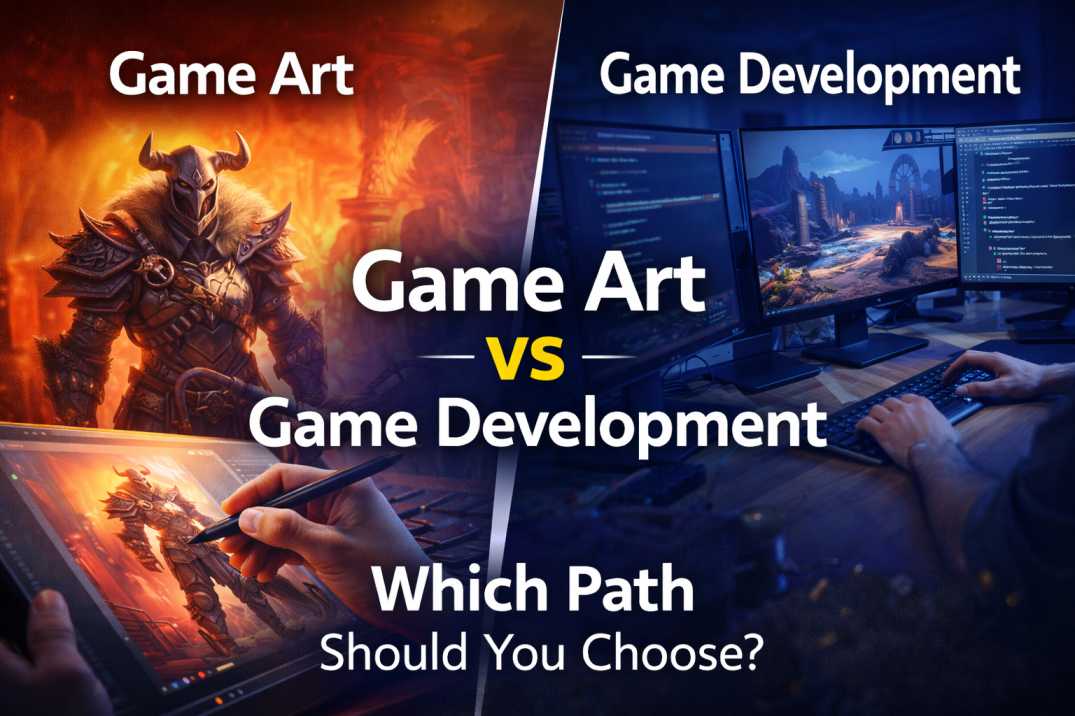
Game art focuses on the visual and creative side, while game development focuses on programming and technical execution.
What Is Game Art?
Game art refers to the visual components of a game. Game artists are responsible for creating the characters, environments, props, textures, animations, and overall aesthetic of a game.
Key Areas in Game Art
Concept Art
Character Design
Environment Art
3D Modeling
Texturing
Lighting
Animation
UI elements
Game artists work closely with game designers to bring visual storytelling to life.
Skills Required for Game Art
Strong drawing fundamentals
Understanding of anatomy and perspective
Color theory and composition
Creativity and imagination
Proficiency in software such as Blender, Maya, ZBrush, Photoshop, Substance Painter
A game art vs game development course focusing on art will emphasize creativity, design principles, and digital sculpting tools.
Who Should Choose Game Art?
Game art is ideal for individuals who:
Love drawing and designing
Enjoy storytelling through visuals
Prefer creative work over coding
Have strong artistic instincts
Are interested in animation or character design
If you are visually driven and enjoy artistic expression, game art may be your path.
What Is Game Development?
Game development focuses on programming and building the technical framework of a game. Developers write code that controls gameplay mechanics, character movements, physics, artificial intelligence, and system logic.
Key Areas in Game Development
Gameplay programming
AI programming
Physics simulation
Game engine integration
Network programming
Debugging and optimization
Developers ensure that the artistic vision functions smoothly in a playable environment.
Skills Required for Game Development
Strong logic and problem-solving
Mathematical understanding
Knowledge of programming languages such as C++, C#, or Python
Understanding of game engines like Unreal Engine or Unity
Debugging and optimization skills
A game art vs game development course focused on development will emphasize coding, algorithms, and game engine workflows.
Who Should Choose Game Development?
Game development suits individuals who:
Enjoy coding and technical problem-solving
Like understanding how systems work
Have patience for debugging
Are comfortable with mathematics
Prefer structured logic over free-form creativity
If you enjoy building systems and solving technical challenges, development may be ideal.
Creative vs Technical Mindset
Game Art
Emotion-driven
Visual storytelling
Aesthetic focus
Creative exploration
Game Development
Logic-driven
System-based thinking
Technical implementation
Performance optimization
Your natural inclination toward creativity or technical analysis often determines the better path.
Career Opportunities in Game Art
Game artists can work as:
Character Artists
Environment Artists
3D Modelers
Texture Artists
Lighting Artists
Concept Artists
UI Designers
The demand for skilled visual artists is strong in gaming, animation, and digital media industries.
Career Opportunities in Game Development
Game developers can work as:
Gameplay Programmers
Engine Developers
AI Programmers
Technical Directors
Unity or Unreal Developers
VR Developers
Developers are in demand not only in gaming but also in simulation, AR, VR, and software industries.
Salary Comparison
Both fields offer competitive salaries, but compensation varies based on experience and specialization.
Game developers often earn slightly higher entry-level salaries due to technical complexity. However, highly skilled game artists with strong portfolios can command premium pay.
Long-term growth depends more on skill mastery than on the path itself.
Learning Curve Comparison
Game Art
Requires continuous portfolio building
Improves with practice and feedback
Creativity evolves over time
Game Development
Requires strong foundational understanding
Coding skills improve with structured learning
Logical thinking sharpens with experience
Both fields require dedication and consistent learning.
Tools Used in Game Art
Maya
Blender
ZBrush
Substance Painter
Photoshop
Unreal Engine for rendering
Tools Used in Game Development
Unity
Unreal Engine
Visual Studio
C++
C#
Python
A comprehensive game art vs game development course introduces industry-standard tools.
Collaboration Between Artists and Developers
Artists create visual assets.
Developers integrate those assets into the engine.
Successful games depend on seamless collaboration between both teams.
Switching Between Paths
Some professionals start in one field and later explore the other.
For example:
A technical artist combines art and coding.
A developer may learn basic modeling for independent projects.
Understanding both disciplines improves career flexibility.
Industry Trends
Real-time rendering technologies like Unreal Engine blur the lines between art and development.
Game engines now allow artists to preview assets in real-time, while developers rely on artistic assets for immersive experiences.
Future demand exists in:
Mobile gaming
AR and VR
Metaverse development
Simulation and training software
Both paths offer strong future potential.
Freelancing and Entrepreneurship
Game artists often freelance for indie studios and global clients.
Game developers can build independent games, apps, or startups.
Entrepreneurial opportunities exist in both domains.
How to Decide
Ask yourself:
Do I enjoy sketching or solving coding problems?
Am I more visually creative or technically analytical?
Do I prefer open-ended design or structured systems?
Can I see myself coding daily or designing characters daily?
Self-awareness helps clarify direction.
Importance of Portfolio
In game art, portfolio quality determines employability.
In game development, project experience and coding proficiency are crucial.
Both paths require practical projects rather than only theoretical knowledge.
Educational Pathway
When selecting a game art vs game development course, ensure:
Industry-aligned curriculum
Hands-on project experience
Access to modern software
Portfolio development support
Placement assistance
Structured learning accelerates career readiness.
Hybrid Roles and Emerging Careers
The industry is evolving, creating hybrid roles such as:
Technical Artist
Game Designer
AR Experience Developer
Interactive Media Developer
These roles combine artistic and technical skills.
Conclusion
Choosing between game art and game development is not about which is better but about which aligns with your strengths and interests.
Game art focuses on creativity, visual storytelling, and design aesthetics. Game development centers on coding, logic, and system building. Both are equally vital in game production and offer promising career opportunities.
Before enrolling in a game art vs game development course, evaluate your natural abilities, interests, and long-term career goals. With dedication, structured learning, and continuous skill development, either path can lead to a successful and fulfilling career in the gaming industry.