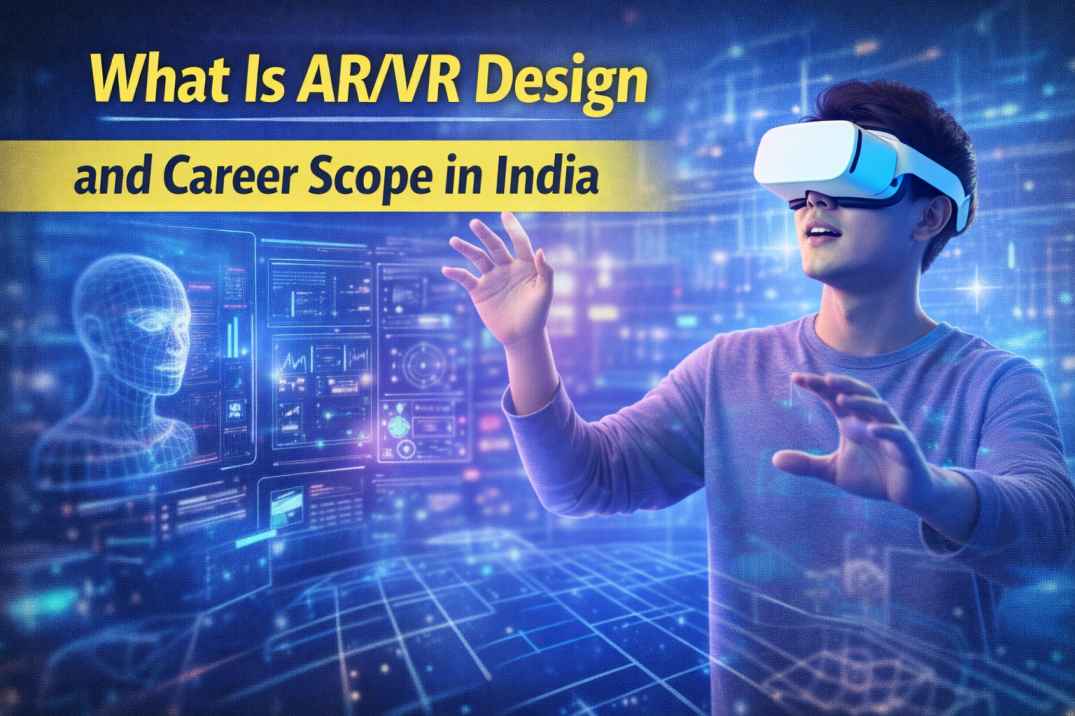
Technology is transforming the way people interact with digital content. In recent years, Augmented Reality (AR) and Virtual Reality (VR) have emerged as powerful technologies that are changing industries such as entertainment, education, healthcare, gaming, architecture, and marketing. These technologies create immersive digital experiences that allow users to interact with virtual environments in ways that were previously impossible.
As India moves toward a digital-first economy, the demand for professionals skilled in AR and VR design is growing rapidly. Many students and creative professionals are exploring specialized programs such as an AR VR design course in Lucknow to build careers in this exciting and innovative field.
This article explains what AR and VR design is, how these technologies work, where they are used, and the career opportunities available in India for aspiring AR and VR designers.
Understanding Augmented Reality (AR)
Augmented Reality is a technology that overlays digital elements such as images, animations, and information onto the real-world environment. It enhances the user’s perception of reality by combining physical surroundings with computer-generated content.
AR applications can be experienced through smartphones, tablets, smart glasses, or AR headsets.
One common example of AR is mobile applications that allow users to place virtual furniture in their rooms before purchasing. In this case, the digital object appears in the real-world environment through the phone’s camera.
Another popular example is AR filters used on social media platforms, where virtual effects are added to live camera footage.
Understanding Virtual Reality (VR)
Virtual Reality is a technology that creates a completely immersive digital environment that replaces the real world. Users wear VR headsets that display a computer-generated 3D environment, allowing them to interact with virtual spaces as if they were physically present.
VR experiences often include interactive elements, sound effects, and motion tracking to create a realistic simulation.
For example, VR can allow users to explore a virtual city, participate in simulated training programs, or experience interactive gaming environments.
Unlike AR, which enhances the real world, VR completely replaces it with a digital environment.
What Is AR/VR Design
AR/VR design is the process of creating immersive digital experiences using augmented reality and virtual reality technologies. Designers combine creativity with technology to build interactive environments that users can explore and interact with.
AR/VR design involves multiple disciplines including:
3D modeling and animation
User interface design
Interactive storytelling
Game design principles
Motion graphics
Programming and development
Designers use specialized tools and software to create objects, characters, environments, and interactive elements within virtual spaces.
The goal of AR/VR design is to create engaging experiences that feel realistic, intuitive, and visually appealing.
Tools and Software Used in AR/VR Design
Professionals working in AR and VR development use various industry-standard tools to create immersive experiences.
Some commonly used tools include:
Unity and Unreal Engine for building interactive environments
Blender and Maya for 3D modeling and animation
Substance Painter for texture design
ZBrush for digital sculpting
Adobe Creative Suite for graphic design and motion graphics
These tools allow designers to create complex virtual worlds and interactive applications.
Students enrolling in an AR VR design course in Lucknow often learn these tools as part of their training to prepare for industry careers.
Applications of AR and VR Technology
AR and VR technologies are being adopted across multiple industries due to their ability to create engaging and interactive experiences.
Gaming and Entertainment
Gaming is one of the largest industries using AR and VR technology. Virtual reality gaming allows players to step inside interactive worlds where they can move, explore, and interact with digital characters.
AR games also combine real-world environments with digital gameplay elements.
Education and Training
Educational institutions are using AR and VR to create interactive learning environments. Students can explore historical locations, conduct virtual science experiments, and experience immersive simulations.
VR training programs are also used in industries such as aviation, medicine, and engineering to simulate real-world scenarios safely.
Healthcare
Healthcare professionals use VR simulations for surgical training and medical education. AR technology also assists doctors during complex procedures by displaying important information in real time.
Architecture and Real Estate
AR and VR help architects and designers visualize buildings before construction begins. Clients can walk through virtual models of homes or offices to understand the design and layout.
Retail and E-Commerce
Retail brands use AR applications to allow customers to try products virtually. For example, shoppers can visualize how furniture fits into their homes or see how clothing looks before purchasing.
Marketing and Advertising
AR and VR are also used in marketing campaigns to create memorable brand experiences. Companies use immersive content to engage customers in innovative ways.
Why AR/VR Design Is a Growing Career Field
The global demand for immersive technology is increasing as businesses explore new ways to interact with customers and improve digital experiences.
India’s technology sector is rapidly adopting AR and VR across multiple industries including gaming, film production, education, and digital marketing.
The Indian government has also identified the AVGC-XR sector (Animation, Visual Effects, Gaming, Comics, and Extended Reality) as a major growth area.
This growth is creating new career opportunities for professionals trained in AR and VR design.
As a result, many students are enrolling in specialized training programs such as an AR VR design course in Lucknow to gain industry-relevant skills.
Career Opportunities in AR/VR Design
Professionals trained in AR and VR design can pursue a variety of roles in the technology and creative industries.
AR/VR Designer
AR/VR designers create interactive virtual environments and experiences. They work on designing digital objects, user interfaces, and immersive storytelling elements.
3D Artist
3D artists design characters, environments, and assets used in AR and VR applications.
Game Designer
Game designers use AR and VR technologies to build immersive gaming experiences with realistic environments and gameplay mechanics.
XR Developer
Extended Reality (XR) developers combine programming and design to build AR, VR, and mixed reality applications.
UI/UX Designer for AR/VR
User interface designers create intuitive navigation systems that allow users to interact smoothly with virtual environments.
Simulation Designer
Simulation designers create virtual training environments used in industries such as healthcare, aviation, and engineering.
AR/VR Content Creator
Content creators develop immersive storytelling experiences for marketing, entertainment, and digital media platforms.
Skills Required for AR/VR Designers
To succeed in AR/VR design, professionals need a combination of creative and technical skills.
Important skills include:
Creativity and visual storytelling
3D modeling and animation
Understanding of user experience design
Basic programming knowledge
Problem-solving abilities
Knowledge of game engines such as Unity or Unreal
Continuous learning is also important because AR and VR technologies are evolving rapidly.
Learning AR/VR Design
Students interested in immersive technology often pursue specialized training programs that combine design principles with technical skills.
A structured training program teaches students:
3D modeling and animation
Interactive environment design
Game engine development
User interface design for immersive platforms
Real-time rendering and simulation techniques
Hands-on projects and portfolio development help students gain practical experience that prepares them for industry roles.
Enrolling in an AR VR design course in Lucknow allows students to learn these skills through professional training, mentorship, and real-world projects.
Future of AR and VR in India
India is rapidly emerging as a major player in the global technology and digital content industries. With increasing investments in gaming, film production, education technology, and digital marketing, the demand for immersive experiences is expected to grow significantly.
AR and VR technologies will play a key role in shaping the future of entertainment, communication, and digital interaction.
The expansion of the AVGC-XR sector will create new opportunities for creative professionals, designers, developers, and storytellers.
Students who develop skills in AR and VR design today will be well-positioned for future career opportunities in this evolving industry.
Conclusion
Augmented Reality and Virtual Reality are transforming the way people experience digital content. These technologies are creating immersive environments that combine creativity, technology, and storytelling.
As industries adopt AR and VR solutions across gaming, education, healthcare, architecture, and marketing, the demand for skilled professionals continues to grow.
Pursuing an AR VR design course in Lucknow can provide students with the technical knowledge and creative skills required to succeed in this innovative field.
For aspiring designers, artists, and developers, AR and VR offer exciting career possibilities and the opportunity to shape the future of digital experiences in India and around the world.